
When a drone fails in flight, the first question is why. Without data, the answer is often a guess. Telemetry from the ESCs gives you a record of what the propulsion system was doing before the failure, and that turns a guess into a root cause.
Why telemetry over CAN
Some ESCs offer telemetry on a separate serial wire. Over CAN, telemetry travels on the same bus that carries the commands, so there is no extra signal wire per ESC, every device is identified, and the data arrives in the same flight log as the rest of your flight data. That makes it easy to line up an event on one motor with what the aircraft was doing at that moment.
What can be logged
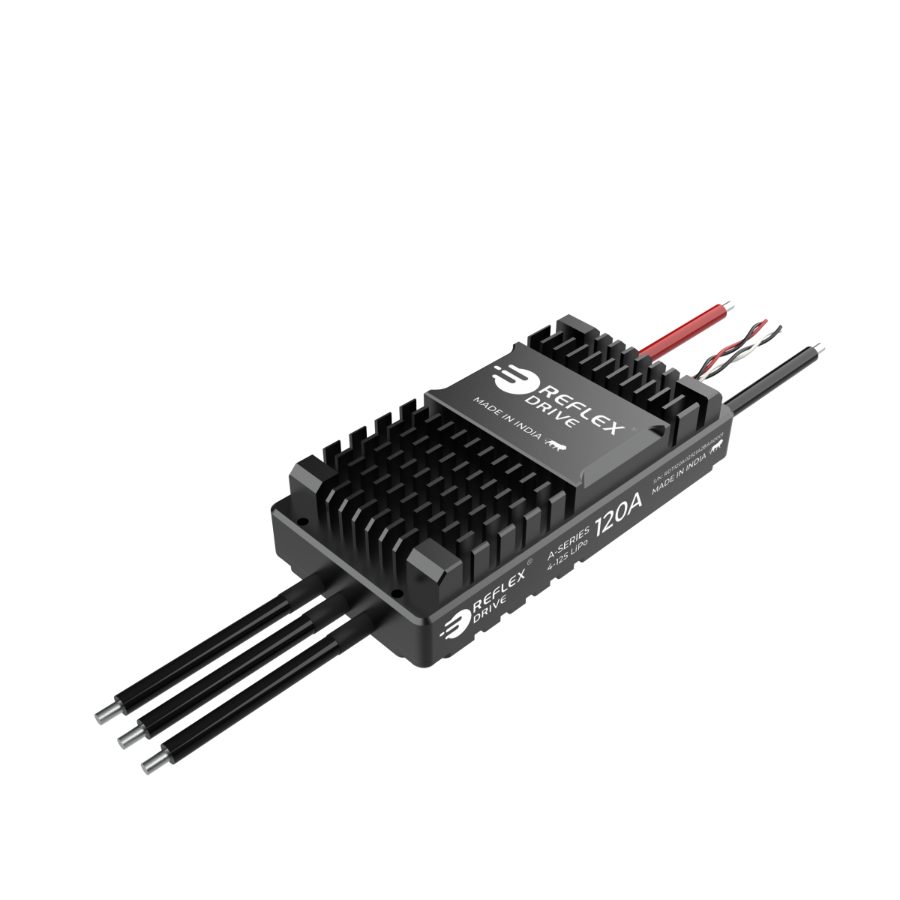
Our A-Series FOC ESCs and IPUs report these values over CAN. Check the datasheet of the product you use for the exact fields.
- Voltage: the battery or bus voltage at the ESC.
- Current: the current drawn by each ESC.
- Motor RPM: the actual speed of each motor.
- Temperature: the ESC temperature, which shows cooling problems early.
- Fault status: flags for events such as overcurrent or over-temperature protection.
How the data helps root cause analysis
- Find the first thing that changed. Look at all rotors on one timeline. The motor whose current, RPM or temperature moved first usually points to the origin.
- Separate cause from effect. A voltage sag followed by RPM drops points to the battery or wiring. One ESC overheating while the others stay cool points to that unit, its airflow or its motor.
- Check the commanded value against the response. If the flight controller asked for more RPM and the motor did not deliver, the problem is downstream of the command.
- Read the fault flags. A protection event tells you what the ESC saw, and the other values show what led up to it.
- Compare with earlier flights. A value that looks normal in isolation may be unusual compared with last week’s logs.
Good logging habits
- Log every flight, not just failures, so you have a baseline.
- Record the aircraft, payload and ambient conditions with the log.
- Keep logs with serial numbers or unit identities so you can follow one ESC over time.
- Keep a consistent log rate that is fast enough to catch short events.
The next post looks at using the same data to predict problems before they happen.
Talk to our engineers
If you are planning a platform and want help choosing a propulsion setup, email [email protected] or call +91 9151118036. You can also try the Drone Builder to size motors, ESCs and propellers for your aircraft.
