
Most hobby ESCs take a PWM or DShot signal and nothing else. As drones get larger and more critical, many builders move to CAN, a robust two-wire bus that carries commands and data in both directions. This post explains the advantages.
PWM in one line
PWM is a one-way signal, usually one wire per ESC, carrying only the throttle command. The ESC never tells the flight controller anything back.
What CAN adds
- Two-way communication. The flight controller sends commands and the ESC sends data back, so the aircraft knows what each motor is doing.
- Fewer wires. All ESCs share one bus, so wiring is lighter and simpler than a signal lead per motor, which matters on large multirotors and VTOL aircraft.
- Noise resistance. CAN uses a twisted differential pair and was designed for electrically noisy environments such as vehicles, which suits a drone with high-current power electronics.
- Error detection. The protocol detects corrupted messages, so a glitch is less likely to become a bad throttle command.
- Addressing. Each device has its own identity, so the system can control and monitor individual ESCs and add other devices to the same bus.
- Room to grow. Power distribution boards, batteries and other devices can join the same bus.
What to check before you adopt it
CAN is a physical bus, and the messages on top of it vary between protocols. Confirm that your flight controller firmware supports the protocol you plan to use, plan the bus layout with correct termination, and test the setup on the bench. Our team can help you with the settings for our products.
Where to find it
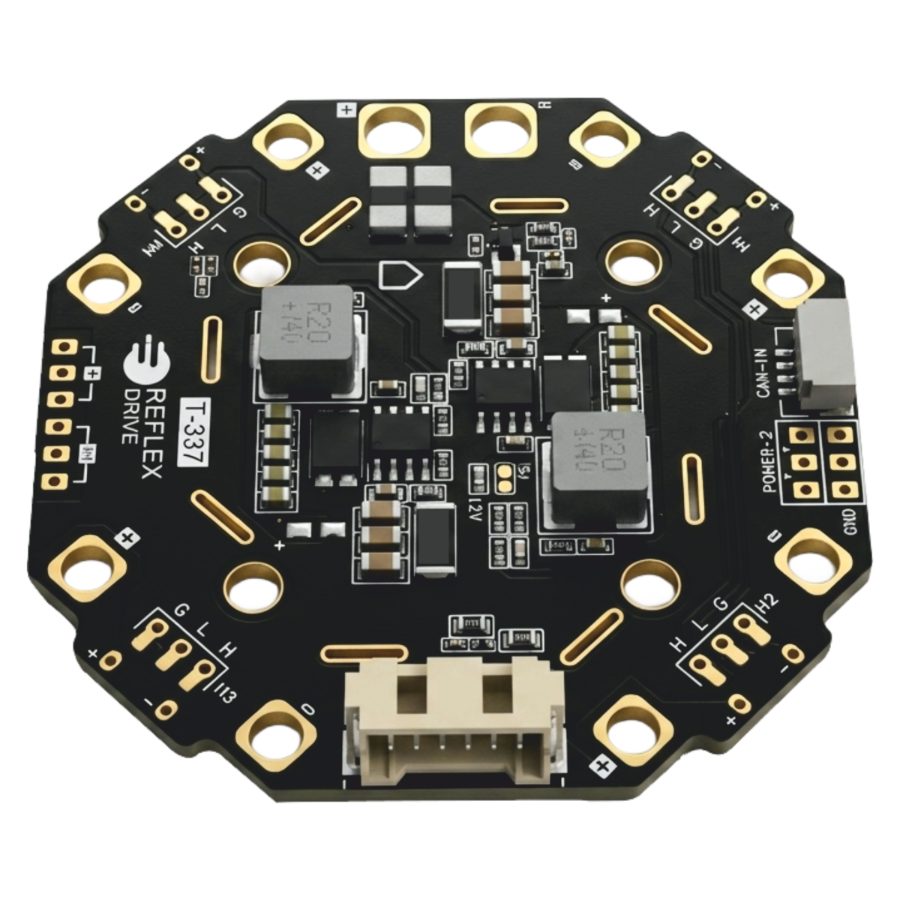
Our A-Series FOC ESCs, R6 IPU and I8 coaxial IPU support both PWM and CAN, so you can start with PWM and move to CAN later. The 150A power distribution board adds CAN bus expansion points to your system. See each datasheet for details.
Talk to our engineers
If you are planning a platform and want help choosing a propulsion setup, email [email protected] or call +91 9151118036. You can also try the Drone Builder to size motors, ESCs and propellers for your aircraft.
